
Elite men climb the standard 15 meter speed wall in under five seconds, and elite women in under six. The men's world record stands at 4.54 seconds, set by Zhao Yicheng of China in May 2026. That is roughly 3.3 meters of vertical gain every second, on a wall that leans five degrees over your head. I have held that record, so this page is written from inside the numbers.
How fast is speed climbing, really?
A world-class run covers 15 meters in less time than it takes to read this sentence out loud. At 4.54 seconds, the average speed is over 3.3 meters per second, and that includes a standing start. The peak speed in the middle of the wall is well beyond the average, because the first movement off the pads and the final leap to the buzzer bracket a section where the best climbers are sprinting on their fingertips.
What is the speed climbing world record right now?
Three records matter, and all three moved in 2026:
- Men's 15 m: 4.54 seconds. Zhao Yicheng of China, set in the semi-final at the World Climbing Series in Wujiang on May 10, 2026.
- Women's 15 m: 5.99 seconds. Emma Hunt of the United States, set in the quarter-finals in Krakow on July 4, 2026, the first woman ever under six seconds.
- Speed Mixed Relay: 10.89 seconds. Emma Hunt and me, set in the final of the same Krakow event, the first record ever written in the discipline.
How has the record moved recently?
The last year of the men's record tells you everything about the pace of this sport:
- My 4.64 stood as the world record into April 2026.
- Zhao Yicheng ran 4.58 at the Asian Beach Games in Sanya on April 28, 2026.
- Twelve days later he took it to 4.54 in Wujiang.
Before that, the record fell twice in a single competition at Paris 2024, both times to me. It has fallen four more times in the two years since, twice to me in Bali in 2025 and twice to Zhao in 2026.
How tall is the speed climbing wall?
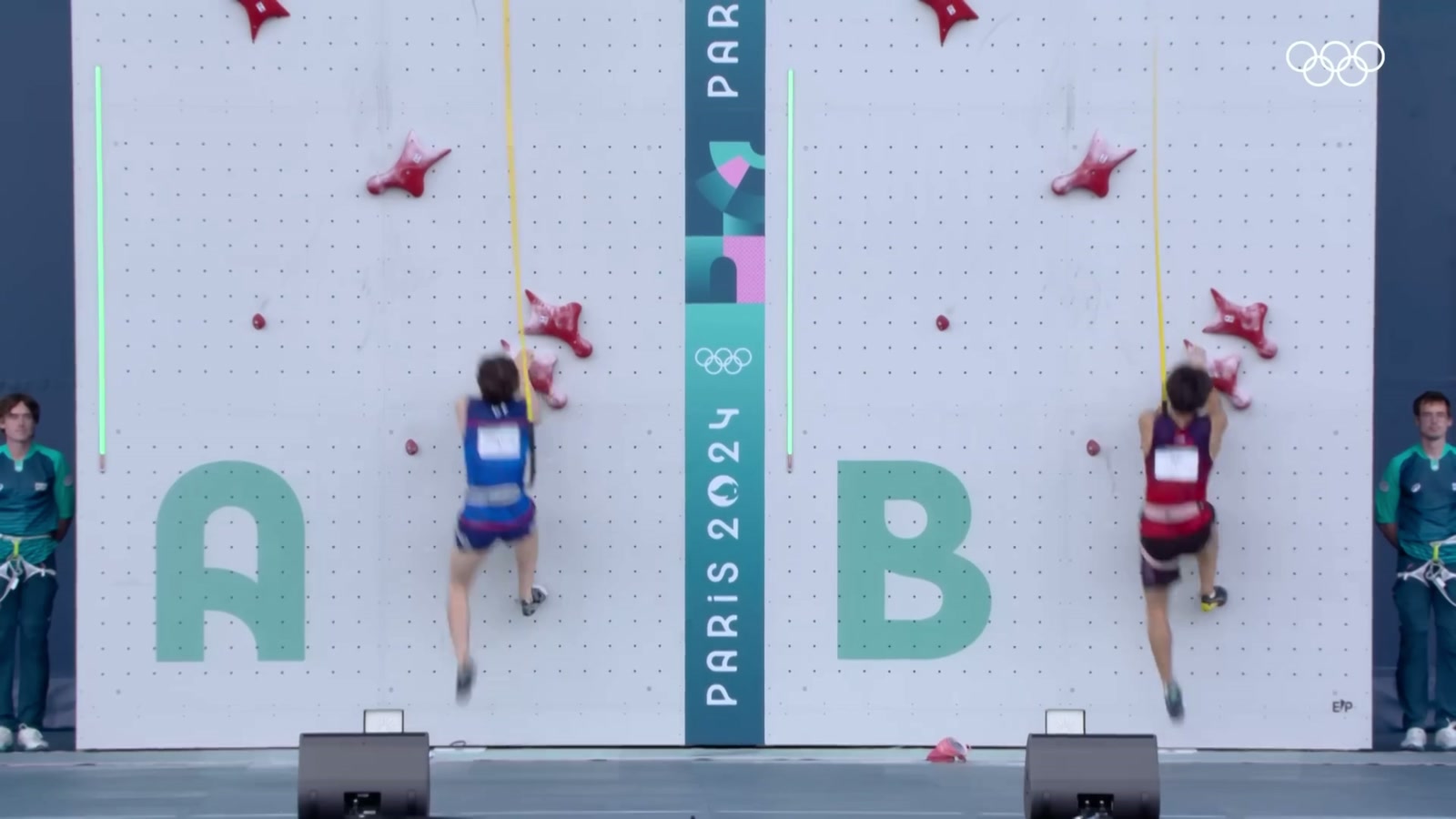
The wall is 15 meters tall with a five degree overhang, and it is identical everywhere in the world: the same holds, in the same positions, at the same angles, in every country. Two lanes run side by side so the race is head to head. My full breakdown of the wall and every hold is on LearnSpeedClimbing, which I built for exactly this reason.
Why is the route always the same?
Standardization is what makes a world record possible. In bouldering and lead climbing the routes change every competition, so times and grades cannot be compared across events. Speed climbing fixed the route, and the moment the terrain froze, the discipline became a pure measurement of the athlete. A hundredth of a second in Jakarta means exactly what it means in Salt Lake City.
How do speed climbers go that fast?
Short version: we memorize the route so completely that the body runs it like a single rehearsed movement, we skip holds where a straighter line preserves momentum, and we train the start and the finish more than anything in between. The longer version is a full article: read my anatomy of a sub-4.7 second run, or go deeper into the technique that changed the sport.
Where do I sit on the all-time list?
I broke the men's world record twice at Paris 2024 at 18 years old, and my 4.64 stood as the record into 2026. My personal best is 4.60, set winning the Krakow World Cup final on July 4, 2026. The full run of results, every event and every time since 2021, is on my results page.
Quick answers
Who is the fastest climber in the world?
By world record, Zhao Yicheng of China, at 4.54 seconds. The fastest woman is Emma Hunt of the United States at 5.99 seconds.
How fast is speed climbing in miles per hour?
A 4.54 second run averages about 7.4 mph straight up. For a sense of scale, that is faster than most people can climb a ladder flat out, sustained up five stories of overhanging wall.
Is the speed climbing wall the same at every competition?
Yes. Height, angle, holds and hold positions are standardized worldwide. That is the entire reason records exist in this discipline.
Has anyone climbed 15 meters in under 4.5 seconds?
Not yet. The record is 4.54, and the sport argues constantly about where the floor is. My honest guess: somebody goes under 4.5 within a few seasons, and I intend to be in that conversation.
Want the full system behind these numbers? Every drill, every hold, every second: it is all on LearnSpeedClimbing.
Learn speed climbing →