

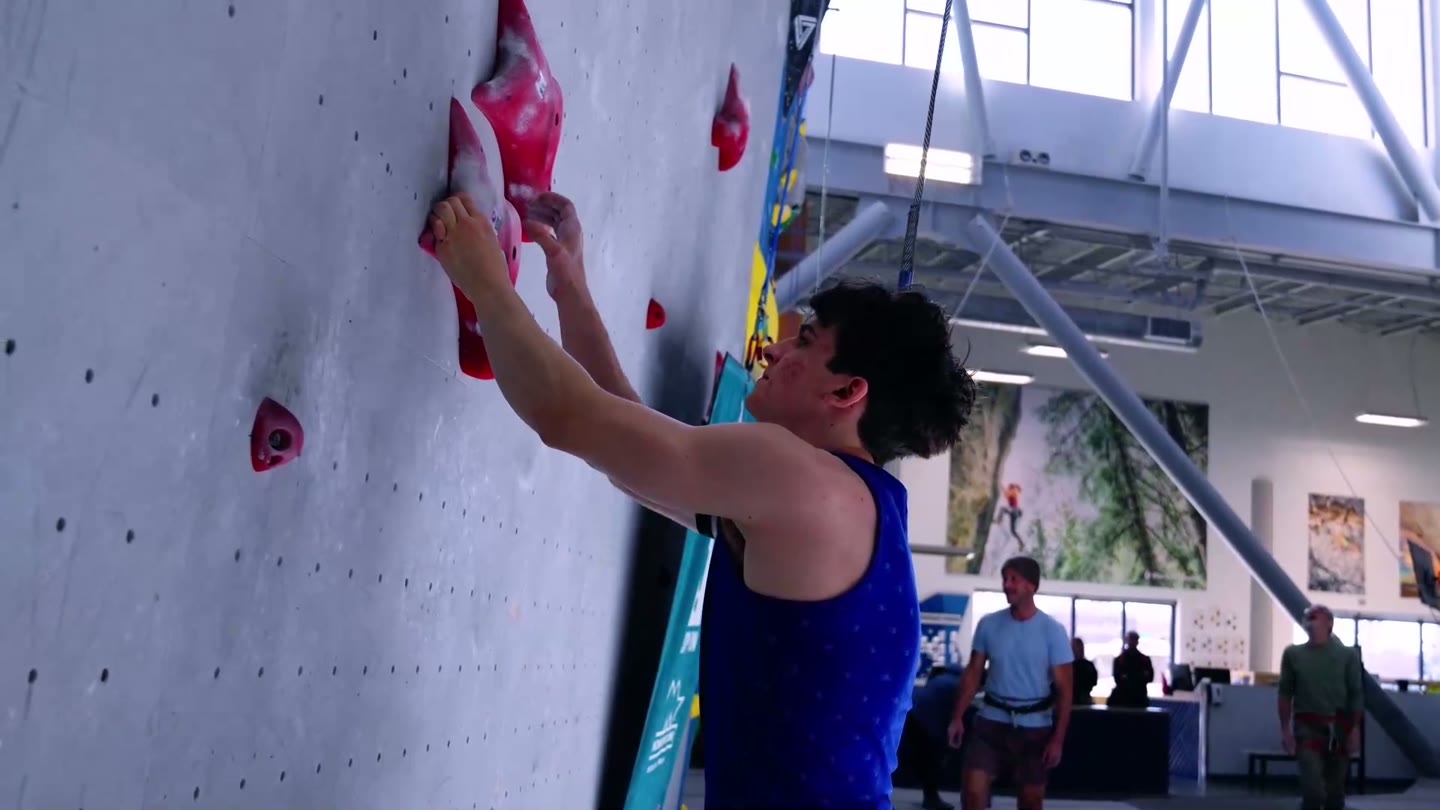
The Tomoa Skip is a speed climbing move that bypasses a hold low on the standard 15 meter route. Instead of shifting sideways through the intended sequence, the climber steps onto a hold their hand has just left and drives straight up to the next handhold. It was introduced by the Japanese climber Tomoa Narasaki, and today nearly every elite speed climber runs some version of it. I am one of them.
What is the Tomoa Skip?
Low on the standard route there is a sequence that, climbed as designed, pushes you sideways before it lets you go up. Narasaki's insight was that the sideways move is wasted distance. By using a foothold in an unintended way, you can cut the lateral shift entirely and carry your momentum diagonally through the lower wall. Get it right and you arrive at the middle section with speed you never have to rebuild. Get it wrong and the run is effectively over before the fifth second of your race.
Who invented the Tomoa Skip?
Tomoa Narasaki, better known internationally as a boulderer, brought the move into speed climbing while preparing for the Tokyo Olympics, when every combined-format athlete had to race the clock as well. The discipline's signature move came from an outsider looking at the wall with fresh eyes, and within a couple of seasons it went from novelty to standard beta at the top of the sport.
Why does skipping a hold make you faster?
Speed climbing is a momentum sport. Every change of direction costs you, because force spent moving sideways is force spent not moving up. The skip straightens the line through the lower wall, so the speed you generate off the start carries further up the route. The gain comes from wasting less.
How much time does it actually save?
I am careful with numbers here, because the honest answer is: it depends on the athlete, and the published analyses say the same thing. The pattern researchers found matches what we see in training: best-case runs get faster, but the move raises the risk in every run, because it loads a single foot placement with your whole race. The skip trades a faster ceiling for a higher chance of ruining the run, and at this level everyone takes that trade because you cannot win without it.
What goes wrong when you get it wrong?
The failure is almost always the foot. Millimeters too high or too low on the receiving hold and the drive goes through a bad angle, the hips fall away from the wall, and the run dies in the middle where you should be at maximum speed. In a head to head race, a missed skip hands the race to the other lane while you are still reorganizing.
Should you learn the Tomoa Skip?
If you are new to speed climbing: not yet. The skip is a multiplier on a foundation, not a substitute for one, and drilling it before your start and your ladder rhythm are solid will make you slower, not faster. If you are running consistent clean times on the standard beta and your plateau is real, the skip is usually where the next chunk of time lives. Be honest about which climber you are.
How I drill it
I isolate the lower wall and run the skip section on its own, over and over, at full intent, because the move does not exist at half speed. Then I stitch it back into full runs and check one thing, whether my middle-wall speed is higher than it was on the old beta. I let the stopwatch decide, because the feeling lies. The full drill progressions, hold by hold, with video, live on LearnSpeedClimbing, and you can see where the skip fits inside a complete race in my breakdown of a sub-4.7 second run.
Quick answers
Do all speed climbers use the Tomoa Skip?
Nearly all elite climbers do, in some variation. At the recreational level it is much rarer, because the move demands a level of foot precision that only comes with serious volume.
Is the Tomoa Skip legal?
Completely. The rules fix the wall, not the sequence. You can touch the holds in any order and any way you like. The clock is the only judge.
Can beginners learn it?
Beginners can attempt it, but it usually costs them time until their fundamentals are fast. Build the boring foundation first. The skip will still be there.
Want the full system behind these numbers? Every drill, every hold, every second: it is all on LearnSpeedClimbing.
Learn speed climbing →