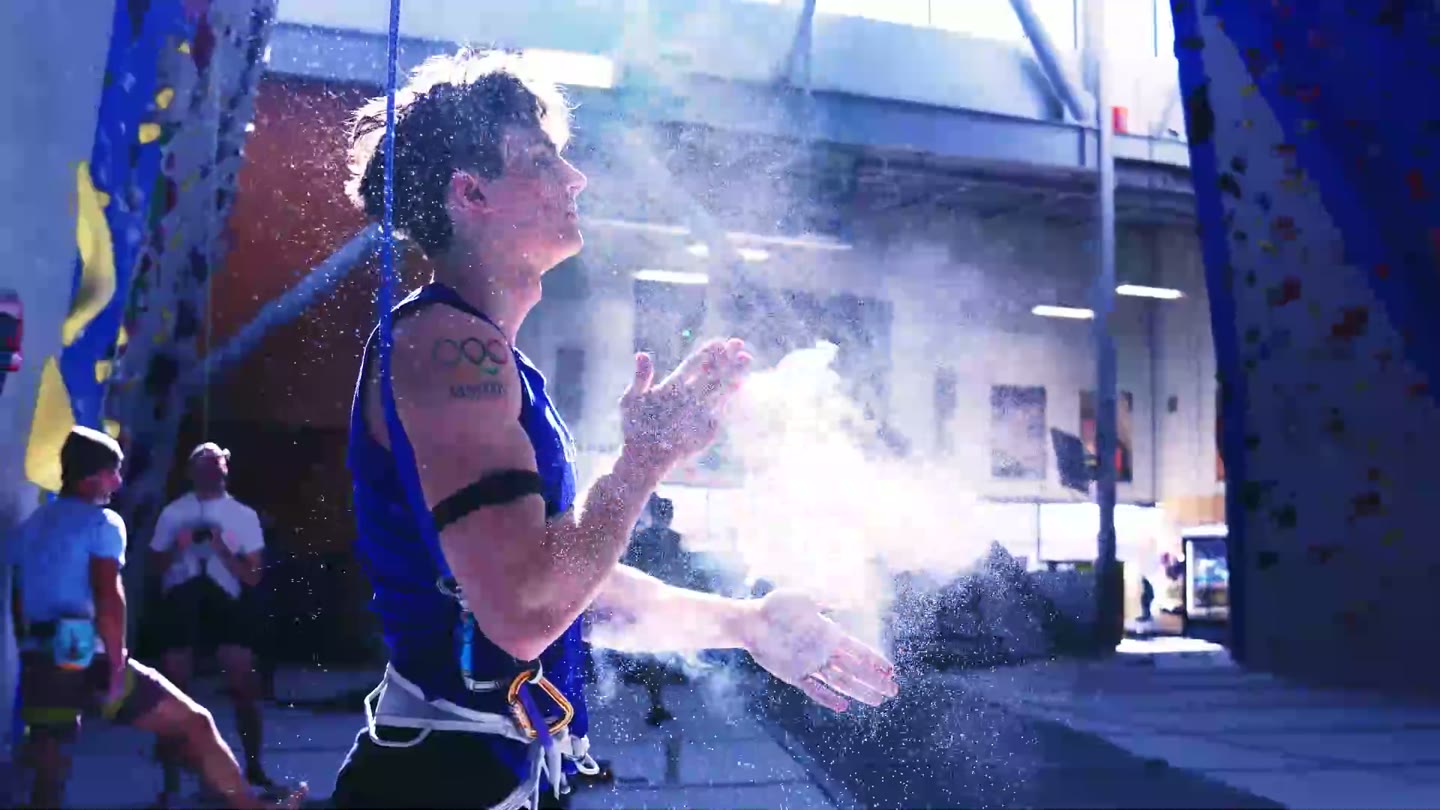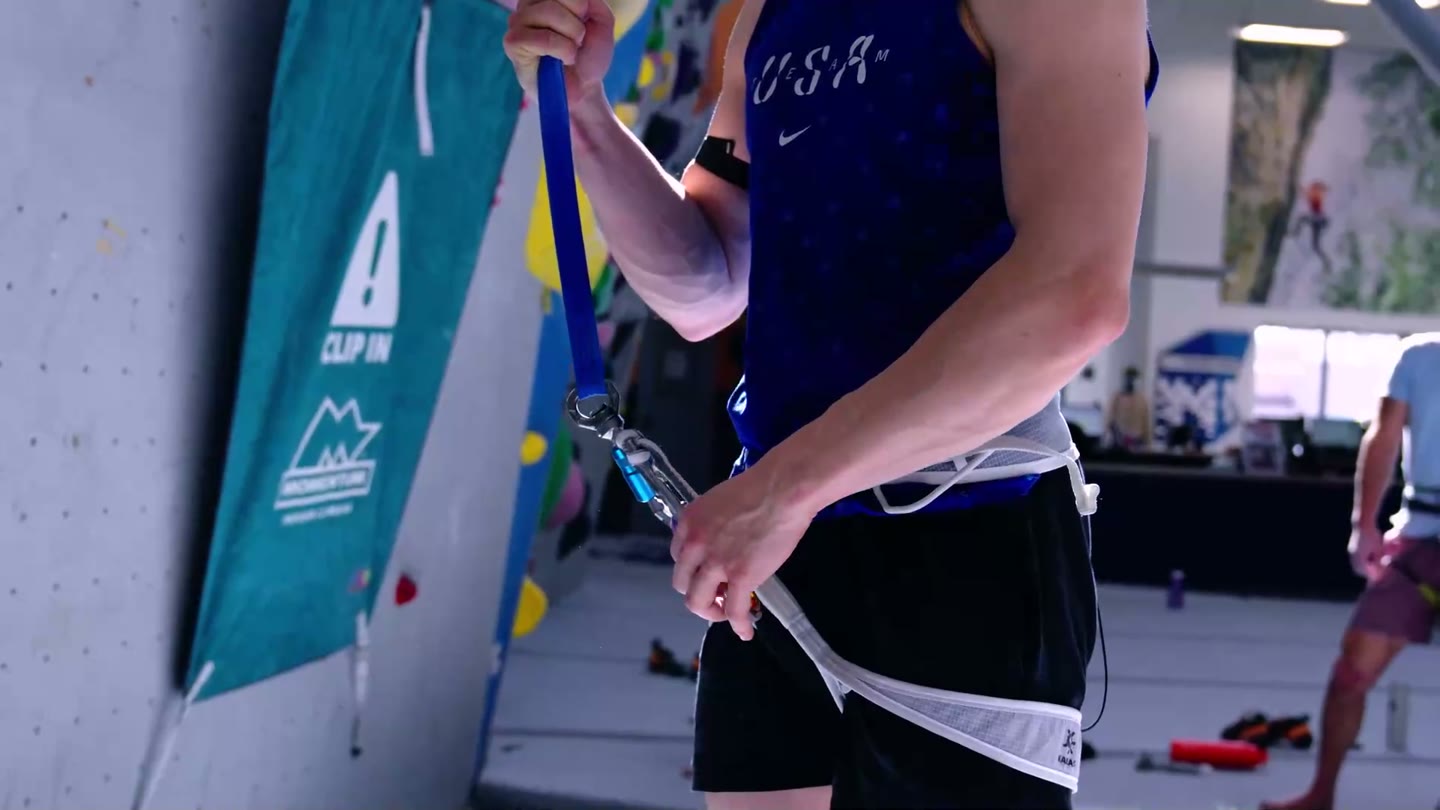

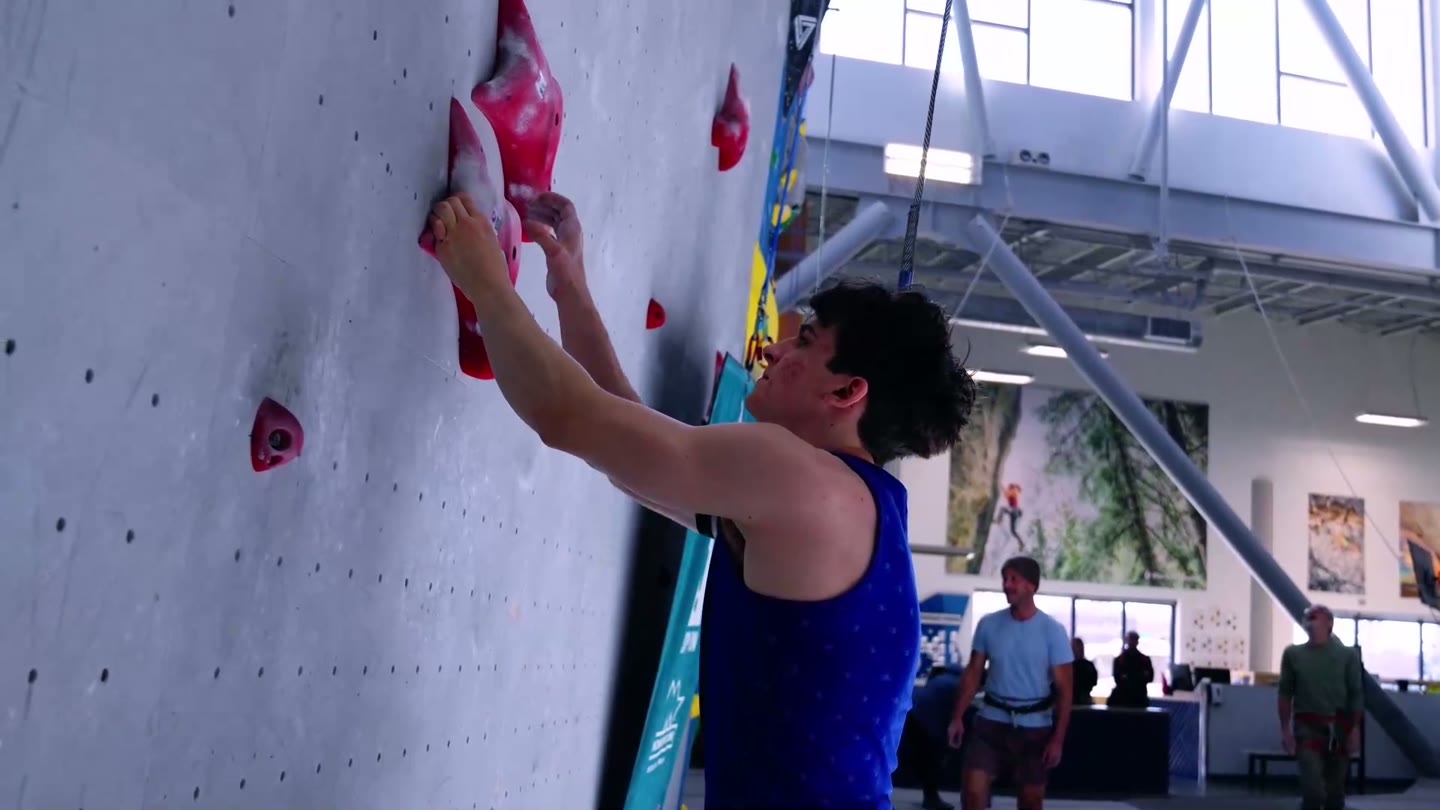
Speed climbers cover the standard 15 meter wall in under five seconds by memorizing a fixed route so completely that the whole climb becomes one rehearsed explosion: a reaction start, a straightened line through the lower wall, a rhythm section in the middle, and a leap at the buzzer. A world-class run lasts about as long as it takes to read this sentence. Here is where those seconds actually go.
Why is the route always the same?
Everything about how we climb this fast starts with one fact: the wall is standardized worldwide. Fifteen meters, a five degree overhang, identical holds in identical positions at every competition on Earth. Because the terrain never changes, the route can be drilled until it lives in the nervous system, and that is the real answer to how anyone climbs 15 meters in under five seconds: by the time it counts, nobody is thinking.
The start: 0.0 to 1.0
The clock starts at the beep, but the run is won before it. Feet set, hips already loaded, first hand moving as the tone fires. A poor reaction costs a tenth before you have left the ground, and at this level a tenth is the podium. The start is trained like a sprinter trains blocks: short, maximal, endlessly repeated, with long rests, because the quality of the first movement decides the price of every movement after it.
The Tomoa skip: 1.0 to 2.2
The signature move of modern speed climbing: bypassing the route's intended lower sequence to carry momentum diagonally through the bottom wall instead of shifting sideways. Get it right and you arrive at the ladder section with speed you never have to rebuild. Get it wrong and the run is already over. I wrote a full explainer on the move, where it came from and when it is worth the risk, in the Tomoa Skip, explained.
The ladder: 2.2 to 3.8
The middle of the route is where the route map in your nervous system takes over. Nobody thinks their way through the ladder at full speed. This is why volume matters: thousands of repetitions so that the fastest sequence is the only sequence your body knows. Watch the middle of an elite run in slow motion and you will see something closer to a dance pattern than to climbing, hands and feet arriving where they must before the eyes could possibly have guided them.
The dyno and the pad: 3.8 to 4.6
The finish is a leap of faith at full extension. The best finishers commit a move early, flying at the pad while their opponent is still climbing to it. It is the highest-risk moment of the run and the one crowds remember, because for a fraction of a second the fastest climbers in the world are simply airborne, betting everything they built over the previous four seconds on one open hand.
What separates a 4.7 from a 5.2?
Not strength, usually. The gap is in transitions: the hundredths bled between sections, the micro-corrections a less-drilled body makes without noticing, and above all the start. When I coach someone stuck in the low fives, we almost never work on their fastest moves. We work on the joins between them, removing hesitations one at a time.
The clock never lies. There is nothing to argue with, which is most of why I love this sport.
How do you practice each section?
Isolate, then integrate. Sections get trained on their own at full intent, then stitched back into complete runs where the stopwatch judges the whole. I described how those pieces build into a real week in how speed climbers train, and every drill I use is published hold by hold on LearnSpeedClimbing.
Quick answers
How long does it take to climb the 15 meter wall?
The men's world record is 4.54 seconds and the women's is 5.99. Strong recreational speed climbers land between 6 and 10 seconds. All the current numbers are in my records explainer.
Do all speed climbers use the same sequence?
Almost. The elite field has converged on nearly identical beta, including the Tomoa Skip, with small personal variations in footwork and timing. On a fixed route, the fastest line is a discoverable fact, and the sport has largely discovered it.
What is the hardest part of a speed run?
Ask ten climbers and most will say the start, because it is the one section where time is lost before any climbing happens, and the only one you cannot correct mid-run.
Want the full system behind these numbers? Every drill, every hold, every second: it is all on LearnSpeedClimbing.
Learn speed climbing →